
AI writing is boring everyone and I think one sentence pattern is doing most of the damage.
One of the worst things about being an insatiable reader is that you notice patterns in writing. Readers are sponges, in a way, so it makes sense that they build internal filters that notice patterns. As an avid reader of science fiction and horror, I often flag certain phrases in the back of my mind. They aren’t bad, just something that pops up like a crack in a sidewalk. She let out a breath she didn’t know she was holding.
I attended a WordPress online conference during COVID. I’m kicking myself for not remembering the name of the speaker, but the topic was all about the hot new AI tools folks were using to write in 2021
“Are you worried?” someone asked a presenter. The attendee was referring to content marketing and all the writing that goes into a website.
The speaker paused, considered that question. “No. Most people don’t write very well. Why would AI trained on that be a threat to good writing?”
I think about this exchange every time I catch particular quirks of AI writing in everyday life: mostly in online ads, social media captions, and even on Reddit, where users are hyperaware of AI-writing flags. Today, let’s discuss my least favorite AI writing quirk of all.
AI Reaches for Contrastive Negation Every Time
If I have to read another contrastive negation, I will remove myself from society to become a swamp witch back home in Louisiana. At least the alligators do not abuse minds with writing that insists it’s clever, making the subtlety feel like a frying pan slamming into a skull.
AI writing loves to write persuasively and, above all, it loves to employ cheap shortcuts that seem on the surface to be profoundly deep. This isn’t a blog, it’s a revelation! But you may think: well, but this is a blog, Court. You’re absolutely right, brilliant reader, and I would never patronize you like that because I’m not a sadistic predictive text-generation machine.
AI loves it’s not X, it’s Y.
It’s just unfortunate that many companies have let that obvious sentence structure leak into their own materials. It’s boring because AI writing does it often which means we are seeing it more and more.
For example, I love Kinsta (go check out their fascinating investigation on bot traffic, here’s my video discussing that bot traffic on Instagram) but I spotted this Instagram ad the other day and immediately screamed OH COME ON:
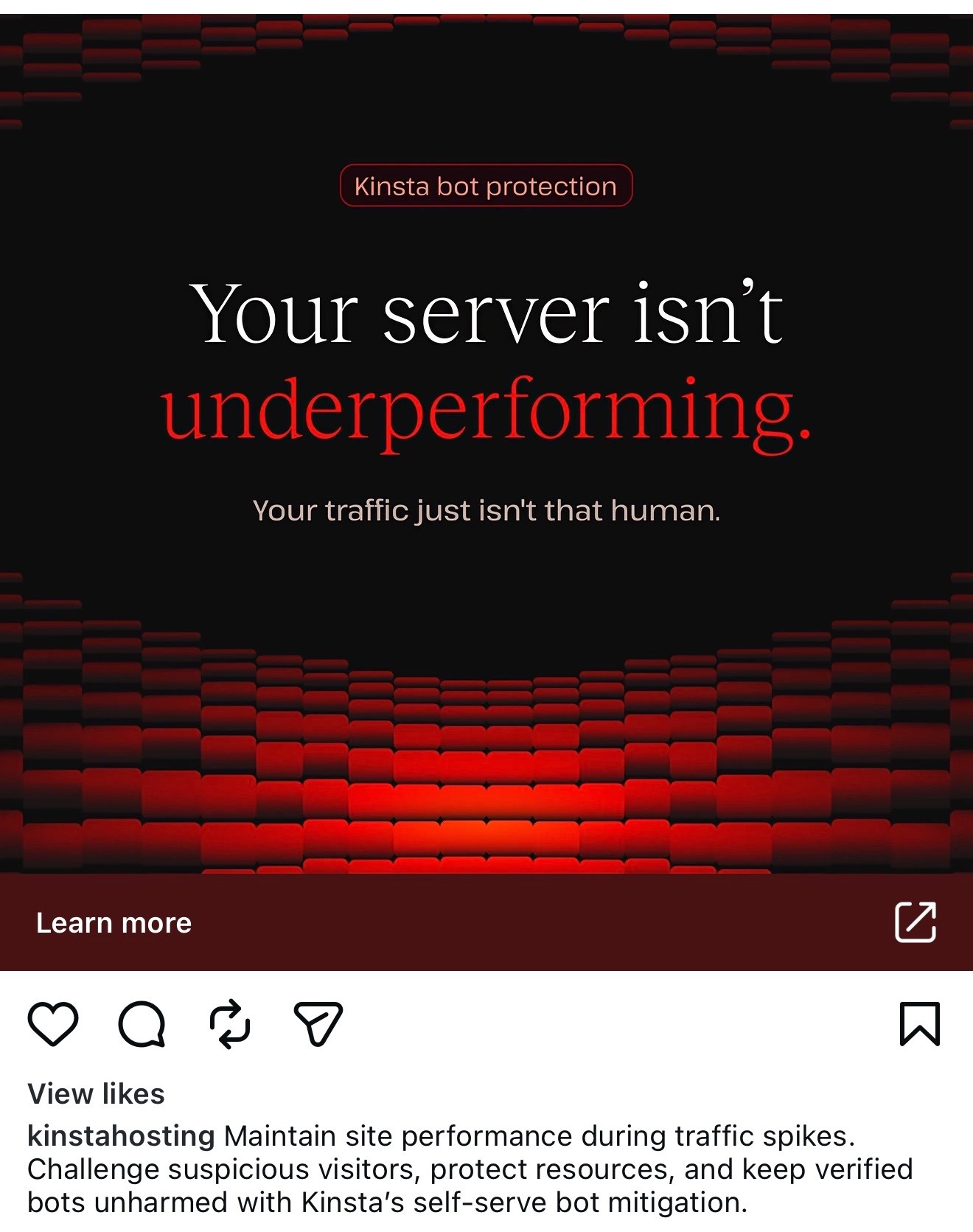
Now, technically this isn’t quite “It’s not X, it’s Y” but you can see it holds the same general je ne sais quoi that the other does. Granted, we have no actual proof that this copy was written with AI but I would assume this to be likely as AI writing loves being clever with any sentiment along the lines of “it isn’t this” which feels in line with this type of pattern.
And because I truly love Kinsta’s dashboard analytics for bot traffic, let’s add one I caught from Atlassian to make sure we don’t make any big tech company too sad today:
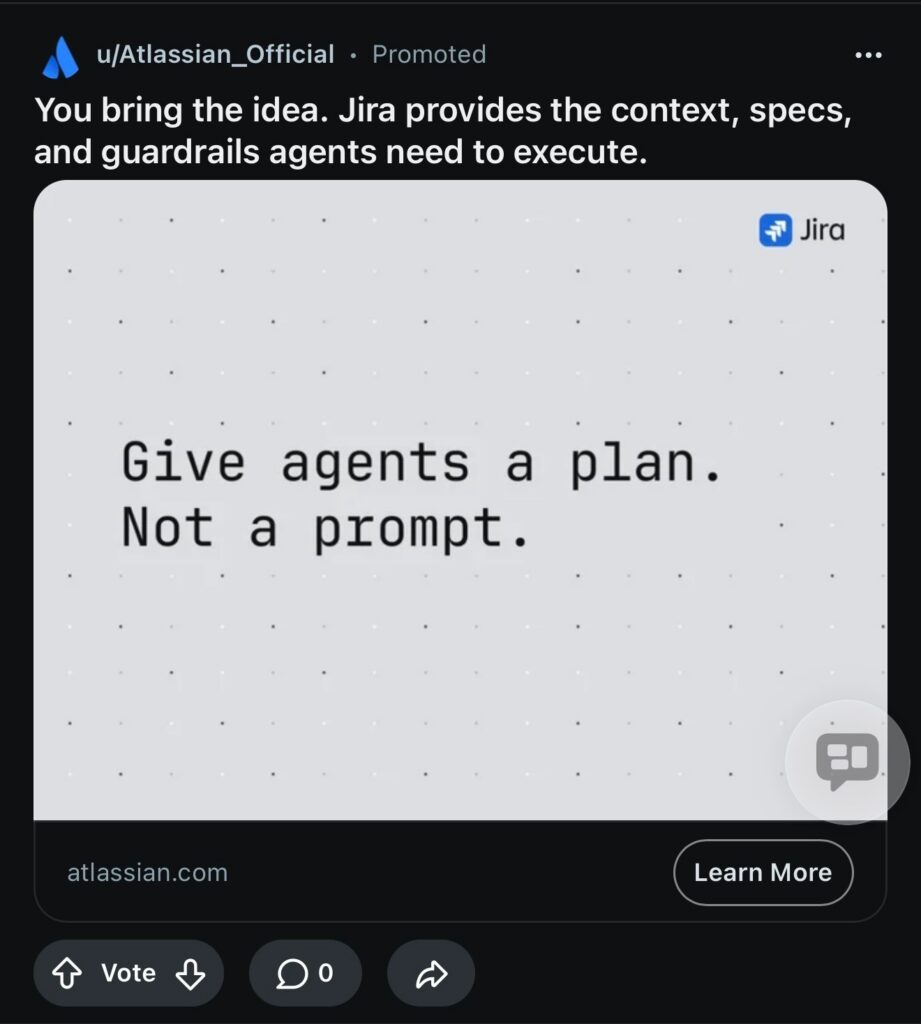
I’m not calling out the people behind these ads. We can’t prove they used AI to write this copy, and even if they did, that’s not a crime. The structure of the Y not X or it’s not Y, it’s X is just a distinct quirk of AI writing.
Marketing is a brutal industry. When copy lands flat, it usually means a board of directors—people who haven’t been inside their target demographic in decades—overruled the people who actually know what they’re doing. I get why this kind of language appeals to leadership. It feels edgy enough to seem current, but it’s been sanded down to nothing. It is a sterile type of sexy.
The thing is though… users are smart. I genuinely believe that, even accounting for the man I once spoke to at a past job who insisted that any software requiring updates was, by definition, poorly made. (I won’t get into why that’s wrong, but the short answer is that security patches exist for a reason.) The point is that most users are smart enough to get what they need out of technology. They pick up on things, even when they can’t articulate what those things are.
People are noticing because people are bored. Why are they bored? Well, probably because literally every single model does this so every brand is using this type of language.
We like the scientific method here though so let’s do an experiment! For our test, we will use ChatGPT, Gemini, and Claude.
Three Models Walk Into a Prompt
Let’s go to a private browser in a non-logged ChatGPT account and ask it:
Act as a marketer and copywriter for a series of online ads to be shown on social media. Be persuasive and punchy. The campaign is about Courtney’s Bot Protection, Courtney being the name of a website hosting company. Clients are worried about server performance. There is a rise of bot traffic happening on our servers. Give me three variants.
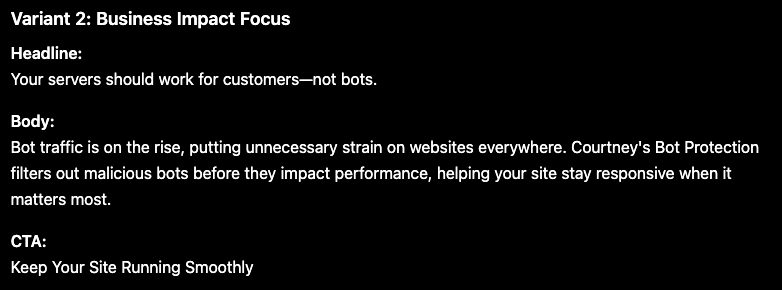
In the second variant, we find this pattern again. Your servers should work for Y–not X. The em dash is a bonus flag. I personally love the em dash and always have but I practice tasteful restraint now, but notice the em dash isn’t really needed? We could just as easily say: your servers should work for customers, not bots.
Our friend Gemini fared even worse I’m afraid with THREE back-to-back examples of this contrastive writing. Here’s the first variant to give an example:
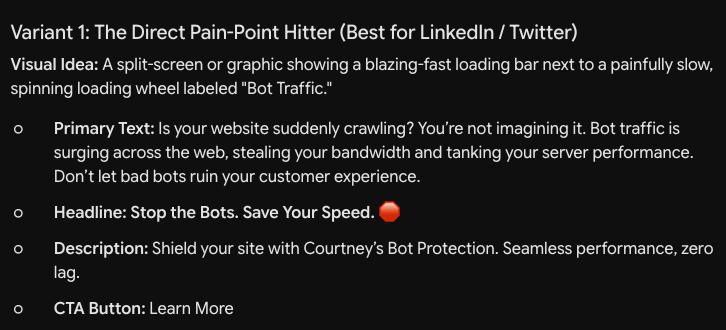
This one is interesting because it’s more of a question but the overall sentiment is: is Y happening? You’re not imaging Y. X is surging!
Now, let’s try a private browser Claude session:
Guess what? It may come as a shock, but the language is right there in the first variant. Y’all smelling what I got on the grill over here? If you are, it’s the same tired phrasing. Quite frankly I’m a hater when it comes to the stale clichés of AI writing.
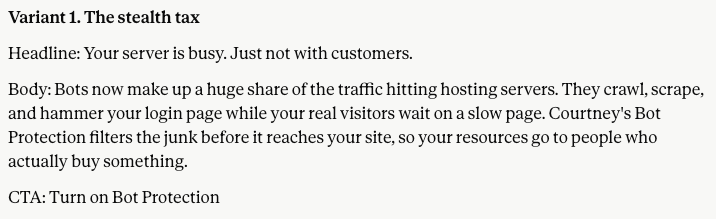
Eagle-eyed readers will also note that AI writing favors following up their bold contrastive hook usually with a statement and bonus points for an additional statement with a series of threes. For example: watch me list one thing, another thing, and this last thing.
I take a firm middle-path when it comes to AI. I believe that one day with the proper regulations, it stands to be an incredible tool for accessibility and administrative assistance. Right now, investors are frothing at the mouth to shove AI tools into everything, which has pushed us all into an absolute battle field when we chat with our friends over beer about it.
Side note: It’s funny that I can recall the conversation around avoiding bloated code at all costs 10 years ago in the tech community only for us to land here with leadership teams insisting that every product be packed to the pixels with AI tools.
Does a fast food app really need an AI chatbot? I truly doubt it but I guess that’s why I’m not an executive doing ketamine at a company retreat in Silicon Valley.
I’m not asking anyone to hound writers who use this. AI learned it from us. The tools are just converging toward the least common denominator as they train. Folks far smarter than I are discussing that so I will put sources and further reading below like always.
Ethical Tech Means Hard Conversations and Being Aware of What Tech Costs Us
As with any discussion of AI, it would be frankly rude to leave out the obvious issue of environmental factors, so I think you should know what this costs.
The buildout driving data center expansion comes largely from corporate decisions. Companies are constructing capacity ahead of demand, and the resulting infrastructure costs get spread across everyone’s utility bills. Meanwhile the environmental burden concentrates in specific communities, disproportionately communities of color already living with worse air quality.
For more information about the disproportionate burden on communities of color, see: Communities Close to EPA-Regulated Data Centers Face Heightened Air Pollution – Environmental Data & Governance Initiative (EDGI)
If you can commit to one resource, I’d recommend the UN University report on the carbon, water, and land footprints of AI. It’s the best source I’ve found so far: Environmental Cost of Artificial Intelligence: Carbon, Water, and Land Footprints (UNU Institute for Water, Environment and Health)
Note: I will have a future piece on how to practice harm reduction as an individual user of AI (especially those who must use it for their job) sooner rather than later.
Like my content? Support me on Patreon. Find me on YouTube, TikTok, and Instagram.
Sources and further reading:
- Paech, Roush, Goldfeder, and Shwartz-Ziv. “Antislop.” October 2025. https://arxiv.org/pdf/2510.15061
- Anil Doshi and Oliver Hauser. Science Advances. 2024. https://www.science.org/doi/10.1126/sciadv.adn5290
- Jiang et al. “The Artificial Hivemind.” UW, CMU, and the Allen Institute. January 2026. https://the-decoder.com/study-warns-ai-could-homogenize-human-creativity-as-models-converge-on-artificial-hivemind/
- Moon, Green, and Kushlev. “Homogenizing effect of large language models (LLMs) on creative diversity.” Computers in Human Behavior: Artificial Humans, Volume 6, 2025. https://www.sciencedirect.com/science/article/pii/S294988212500091X#sec7
Leave a Reply